

How Does Restaurant Interactive Table Technology Work? A Quick & Easy Guide
A restaurant interactive table is a computer-programmed and operated dining table with several interactive elements (i.e., touchscreen) meant to improve the dining experience. Usually including touch screens, projectors, or embedded displays that let consumers interact with the menu, view pending orders, and communicate with the staff or kitchen.
How Does It Work?
The main element is the touch-sensitive display included in the tabletop, either a surface lit by overhead projectors or an embedded touch screen. These touch-activated displays let patrons directly interact with the table. These tables use cameras, capacitive touch sensors, or infrared sensors, among other kinds of sensors, to identify motions and touch inputs.
These sensors transmit the data to a computer or connected server after recording or recognizing human input. By processing the inputs and running the required software programs, the data collected will then be forwarded to another computer or screen that will inform the restaurant of your order. Wi-Fi or Bluetooth connectivity guarantees that the table may interact with other devices inside the restaurant as well as with the ordering and payment systems of the restaurant.
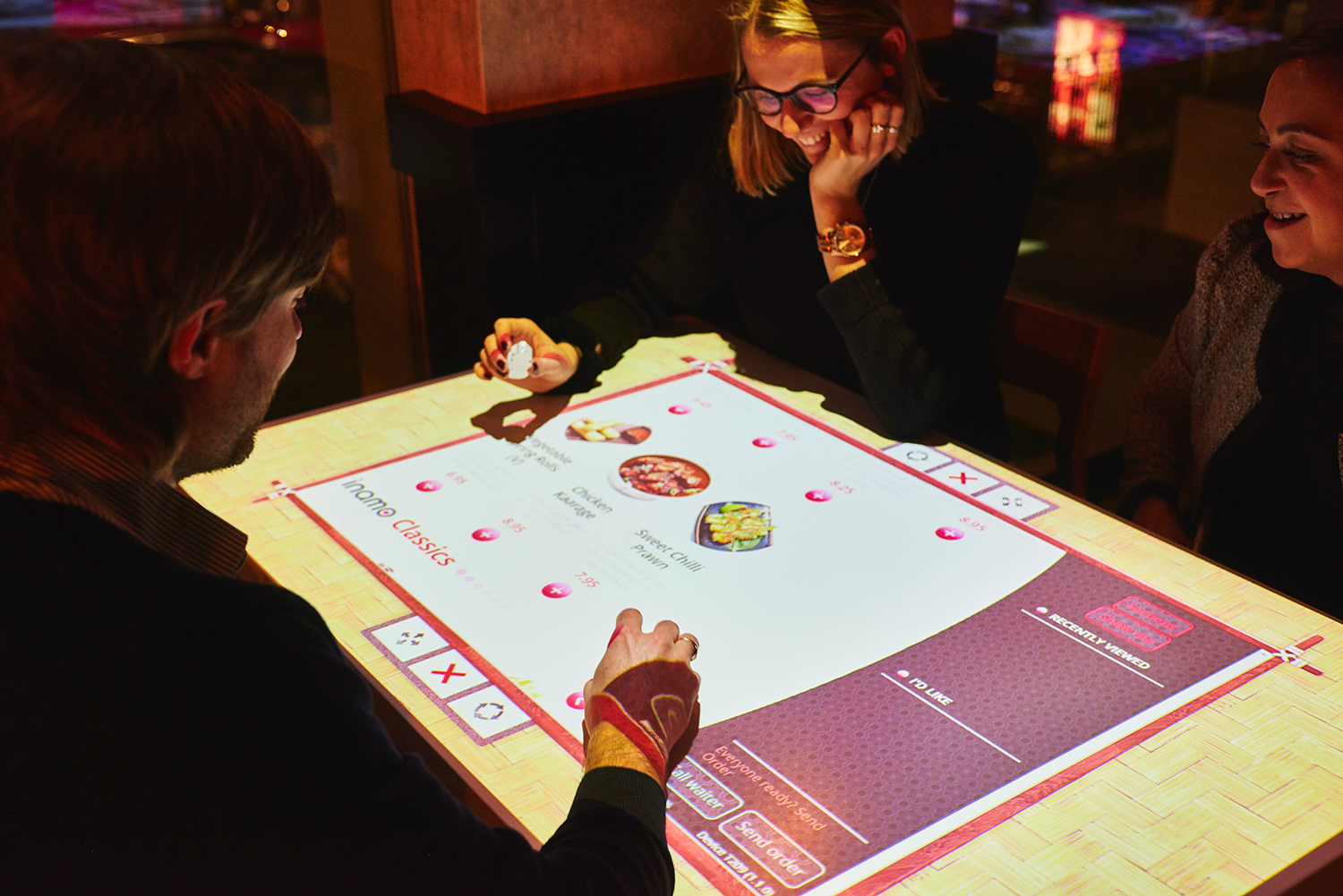
Advanced software drives the interactive experience of the restaurant interactive table. Users can access digital menus, view order screens, and use several entertainment options if available. By integrating with the point-of-sale (POS) system of the restaurant, orders made through the restaurant interactive table will be rerouted to the POS so that the restaurant can keep track of your orders and bills as you enjoy your time.
This integration simplifies ordering by letting orders entered through the table be sent straight to the kitchen and minimizes restaurant staff interaction, especially for diners who would prefer privacy and intimacy. Furthermore, safe payment processing systems let consumers use credit cards and digital wallets to pay their bill right away without calling the staff.
Restaurant employees may quickly change menus, specials, and promotional materials shown on the tables with content management systems. The tables also have entertainment software, which could include games, films, and other interactive tools, to keep guests occupied.
Common Features of the Restaurant Interactive Table
Interactive restaurant tables include a variety of tools meant to improve consumer dining experiences while simplifying restaurant management. The main characteristics are:
Digital Menus
Interactive tables provide guests with computerized menus they may view straight on the tabletop. High-quality photographs, detailed descriptions, and customizing choices for every item abound on these menus, which let patrons fit their orders to their tastes.
Touch Screen Ordering
Orders placed by customers via the touchscreen interface direct themselves straight to the kitchen. This lessens the need for wait staff members to manually process orders, therefore eliminating mistakes and accelerating service.
Payment Processing
Integrated payment systems let consumers pay their bills straight at the table. These systems enable you to pay with credit and debit cards, digital wallets, and mobile payments, among other ways. This ease generally improves the dining experience and accelerates the payment process.
Customizable Ambiance
Certain interactive tables let users change their dining surroundings. To create a unique mood, one can change the lighting of the table, choose background music, or choose from several themes and screen savers.
Interactive Maps and Information
Interactive tables can show venue maps and information for bigger restaurants or those with several locations. This can assist patrons in locating bathrooms, negotiating the restaurant, or learning more about its unique qualities and past.
Nutritional Information and Allergen Alerts
For every menu item, interactive tables can show thorough nutritional information and allergen alerts. This appeals to health-conscious eaters and those with dietary restrictions, so it helps consumers make wise decisions.
Entertainment Options
Interactive tables can include built-in entertainment choices to keep diners interested as they wait for their food. These might comprise games, movies, trivia, and even social media integration. Certain tables also feature augmented reality (AR) experiences, which present interactive and immersive materials.
Order Tracking
From preparation to delivery to their table, consumers can real-time track the state of their meals. This openness keeps consumers updated about the development of their cuisine, therefore improving the dining experience.
Integration with Loyalty Programs
By linking with the loyalty programs of the restaurant, interactive tables let consumers earn and use points right from the table. This honors devoted consumers and promotes return business.
Real-Time Feedback and Reviews
Consumers can, right from the table, write comments and ratings regarding their eating experience. Restaurants can get insightful information and enhance their offerings by means of this real-time input. Diners can also post their experiences on social media, therefore helping to advertise the restaurant.
Language and Accessibility Options
Interactive tables sometimes offer several languages and accessibility tools to serve a varied clientele. This guarantees that the functions of the table may be easily used by every client, irrespective of language or physical capacity. Interactive tables sometimes offer several languages and accessibility tools to serve a varied clientele. This guarantees that the functions of the table may be easily used by every client, irrespective of language or physical capacity.
Types of Restaurant Interactive Tables
There are several kinds of interactive restaurant tables, each with special qualities that fit diverse dining settings and consumer tastes. The following are the major forms of interactive dining tables:
Touch Screen Tables
Touch screen tables let customers interact directly with the table top, especially when placing an order. It usually features digital menus, order placement, payment processing, and entertainment choices to keep customers entertained while waiting for their food.
Touchscreen tables feature an integrated touch-sensitive display buried into the tabletop. An embedded computer handles the touch inputs and then sends data to the restaurant’s ordering and payment systems.
Projection-Based Tables
Using overhead projectors, projection-based tables show interactive content onto the table surface. Customers may interact with the projected content by means of infrared sensors or cameras detecting touch inputs and gestures. Usually more flexible in terms of set-up, these tables may turn any flat surface into an interactive one.
Augmented Reality (AR) Tables
AR tables place digital data and images over the physical world using technology. Through augmented reality, diners and patrons can see images of different menu items in greater detail and access nutritional data, which improves the dining and eating experience.
AR technology overlays digital data onto the actual tabletop. Through AR-enabled devices, consumers may examine comprehensive images of menu items, nutritional information, and promotional material. Using sensors and cameras, the table monitors and analyzes interactions, therefore improving the physical dining experience by digital means.
Multi-User Interactive Tables
For group dining events, these tables are perfect since they are made to support several users at the same time. Their big touch surfaces let several people interact with the table at once, accessing several menu sections, playing games, or interacting with other interactive materials.
Large touch surfaces of multi-user interactive tables that let several people access and interact with the interface concurrently. Every individual can access menus, interact with other information, or use several areas of the table. Multiple inputs at once handled by the table’s sensors and computation unit guarantee groups’ flawless experience.
Advantages of Restaurant Interactive Tables
Improves Customer Involvement
Through their variety of interesting features, interactive restaurant tables greatly improve the customer experience. Often including entertainment choices like games and movies, these tables help to keep patrons occupied throughout their dinner waiting. They also provide customizing choices, which let customers change the lighting, choose background music, or fit their orders to their tastes, so personalizing their dining atmosphere. High-resolution photos and thorough descriptions on detailed digital menus enable consumers to make wise judgments, therefore enhancing their general level of satisfaction.
Simplifies Restaurant Operations
Interactive tables simplify restaurant operations, therefore increasing their efficiency. Reducing order mistakes is one of the main advantages since consumers may enter their choices straight into the system. This guarantees accuracy and speeds up the ordering procedure, therefore reducing wait times and freeing staff members to concentrate on other critical chores.
By allowing consumers to finish transactions at the table, therefore reducing the need for manual handling by waitstaff, the integrated payment processing systems improve efficiency even more.
Enhances Client Interaction
These tables’ interactive elements help to increase client involvement. Restaurants may improve the whole experience by offering a lively and interesting dining space, therefore promoting return business. Review choices and real-time comments let patrons rapidly express their ideas and experiences, therefore enabling restaurants to get insightful information and make quick changes.
Boosts the Restaurant’s Appeal
Restaurants that use interactive tables will stand out from their rivals. Providing a contemporary, tech-savvy dining experience can draw younger, more technologically inclined customers. Furthermore, the novelty and simplicity of interactive tables help to improve the restaurant’s reputation and attract patrons seeking unusual dining choices.
Disadvantages of Restaurant Interactive Tables
High Initial Investment
Interactive restaurant tables can be costly both in terms of installation and upkeep. Hardware, software, and interface with current systems can all have an initial outlay of significant money. Furthermore, adding to the continuous expenses are frequent maintenance and possible repairs, which makes dining at restaurants a major financial commitment.
Possibility of Technical Problems
Dependency on technology indicates that one may have technological problems. Hardware failures, software issues, or glitches could throw off the dining experience and cause client discontent. Smooth operation depends on regular updates and maintenance, which might be costly depending on resources.
Difficult to Clean and Maintain
Particularly in a restaurant, touch displays, and interactive surfaces need regular cleaning to uphold hygienics. Food and drink spills, fingerprints, and ordinary use can quickly dirty the surfaces, so regular and complete cleaning is necessary to guarantee a good and hygienic experience for clients.
Steep Learning Curve
First, by using the new technology, staff members and consumers could have a learning curve. The interactive tables may be difficult for certain consumers—especially those who are not tech-savvy—which would compromise their dining experience. Time and money are needed for staff members’ training to help consumers and oversee technology.
Conclusion
Adding restaurant interactive tables can improve the overall dining experience of customers. Aside from the aesthetic effect that it can contribute, it can also improve your restaurant operations and make the order processing efficient.


 English
  Russian
  Spanish
  Arabic
  German
  Korean
  French
  Portuguese
  Italian
  Persian
  Indonesian
  Turkish