

HDR vs UHD: A Quick & Fair Comparison 2025
HDR vs UHD might sound like a competition, but they’re not rivals—they’re teammates. HDR enhances color and contrast, while UHD sharpens resolution. Each serves a unique purpose, and together, they create an unmatched visual experience. Let’s explore how they work and why they’re both essential.
What Is HDR?
HDR, which stands for “High Dynamic Range,” isn’t just a fancy word for “high contrast.” It’s what makes your screen feel alive. Imagine seeing a movie in which the hero stands in a dark alley lit only by flickering neon signs. The shadows seem flat without HDR, and the neon, while vivid, doesn’t really sparkle the way it ought to. But that alley comes alive with HDR. While the neon shines brilliantly, almost as if you were there, absorbing every detail, the shadows darken and the scene becomes more mysterious.
:max_bytes(150000):strip_icc()/sony-sdr-vs-hdr-b-5bbf9fd0c9e77c0051786eb6.jpg)
Standard Dynamic Range (SDR) vs High Dynamic Range (HDR) Comparison (Source: Lifewire)
Imagine snapping a photograph of the dawn to visualize it still another way. The brilliant sky gets washed away or the darker ground becomes a black blob with an ordinary camera. Like a professional photographer, HDR precisely balances the brightness and shadows so you may view the warm tones of the sun and the subdued textures of the ground all in one amazing view.
On a screen, HDR results in larger range of colors, brighter highlights, and darker blacks. Every tiny detail—from the glitter of city lights to the shimmer of water—is more vivid in Reds pop, greens seem rich. It’s about feeling as like you are part of a situation, not only about seeing one. HDR does precisely this. Every moment is more rich and vivid since it closes the difference between what your eyes see in real life and what your screen can show.
What Is UHD?
UHD, which stands for “Ultra High Definition,” is all about making the picture very clear so that you can see every detail, right down to the freckles on a person’s face or the individual tree leaves. Imagine seeing a nature show where the camera zooms in on a snow leopard sneaking through a cold mountain. With UHD, you can see every hair, count them, and be amazed by how the snow has different patterns. It’s like getting closer to a painting in a gallery—all of a sudden you can see the amazing details that make it so great.
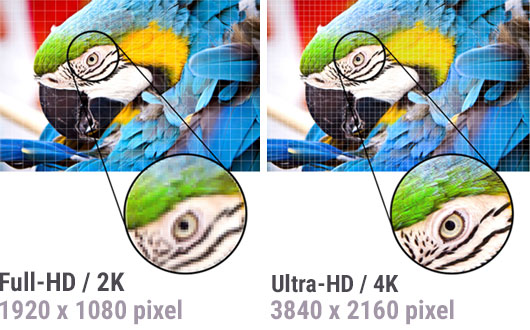
Full HD vs UHD Comparison (Source: Delock)
Another way to say this is that UHD is like going from an old picture to a huge, high-quality poster of your favorite holiday spot. It’s okay with the letter, but what about the poster? Every wave in the sea, every mountain peak, and every cloud puff are shown in great detail. With a quality of 3840 x 2160 pixels, UHD is four times clearer than HD. It makes watching TV so clear and real that it feels like the screen is a window into the world.
UHD display makes sure that nothing gets lost in the noise, whether you’re streaming, playing games, or just watching your favorite show. Each scene looks and feels better, clearer, and more real. You can see everything the person who made the material wants you to see. It’s not just a picture.
HDR vs UHD: Are They the Same?
HDR and UHD are often confused, and it’s easy to see why. Promising to elevate your viewing experience, these are keywords you will find emblazoned across TV boxes and streaming services. The truth is, though, they are really different from one other. Actually, they have rather distinct uses, so knowing the variations helps you to value when and how to apply them.
Imagine your TV as a stage; UHD would be the set design—that clean, clear backdrop that clarifies and details everything. Conversely, HDR is the lighting team; dynamic contrasts and vivid colors help to bring the scene to life. UHD emphasizes resolution; so, it packs more pixels to produce a clearer image. While HDR is all about improving the quality of those pixels, shadows moodier, highlights brighter, and colors more vivid.
Are they therefore compatible? Not at all. HDR relates to quality; UHD relates to pixel count. If you have a UHD TV, those additional pixels could still seem a touch bland without HDR. Likewise, HDR on its alone won’t perform miracles if the screen isn’t UHD since the resolution won’t be precise enough to highlight all those delicious color nuances.
When Should You Use Each Term?
UHD is great for sharper detail on larger screens or while sitting close to the TV. Perfect for gaming, movies with complex imagery, or simply ensuring your screen looks as clear as it might be.
When you want realistic brightness and deeper color depth, use HDR. Watching visually arresting films, streaming nature documentaries, or gaming that transports you into vivid, immersive worlds is great.
The best thing is that most new TVs provide both UHD and HDR simultaneously, where the magic happens. Together, they make your screen more alive and sharper, therefore providing an experience akin to walking into the action rather than only viewing it. Though fundamentally different, they are like peanut butter and jelly that amazing when combined.
Where HDR Is Important
Let’s get right to it: Though its value depends on how you use your screen, HDR (High Dynamic Range) can change the way you view material. HDR offers its own brand of charm whether your relaxing with a movie, fighting it out in a game, or even performing productivity chores. The areas where HDR excels are broken out here:
Movies and Streaming: Seeing Every Detail, Feeling Every Scene
If you enjoy movies, HDR transforms rather than simply a luxury. Imagine seeing a dramatic night scene without HDR: those dark parts can simply seem like a muddy gray glob and the stars in the sky could seem bland. And with HDR? Every brilliant light or shadowed face feels alive; the black people are inky and deep, the stars shine like genuine ones. HDR enhances every frame of a beautiful romance or a blockbuster action movie to transport you into the narrative like never before.
Gaming: Elevating the Thrill of Every Battle
In gaming, HDR is similar to changing from a standard sword to a brilliant magical blade—it simply makes everything more powerful. Every scene is more lifelike with HDR since shadows are darker and more dramatic, highlights are brilliant, and colors seem stronger. HDR provides depth and richness that may improve or ruin the experience whether you’re marveling at an open-world sunset or creeping through darkly lit dungeons. Better contrast also helps competitive players find an opponent hiding in the shadows only a fraction of a second sooner—sometimes the difference between success and loss.
Productivity: Making Your Work Look Better (and More Fun)
Though may not look like a productivity tool, HDR should not be undervalued. For photo or video editors, HDR’s enhanced color spectrum and contrast are priceless. For creative people especially, it guarantees that what you see on your screen reflects the final look of the work. HDR can improve colors and contrasts even for jobs like making presentations or examining spreadsheets, therefore lessening eye strain when you spend hours staring at your screen.
Where UHD Is Important
UHD, or Ultra High Definition, is about changing your interaction with images, not only about improving appearance. Its four times that of Full HD pixel-packed resolution guarantees you notice details you would otherwise overlook regardless of what you are doing. Let us investigate where UHD shines.
Large-Screen Displays: Bigger Screens, No Compromises
UHD is the reason those large TVs or monitors look so sharp; you have seen this when you have strolled into a store and admired those TVs or monitors. Regular HD may seem stretched on big TVs, and seated too close may cause obvious pixelation. UHD fixes this by packing more pixels, hence even on a 75-inch TV the image stays clear. UHD guarantees that size doesn’t compromise clarity whether you’re planning a conference room presentation or viewing a sporting event.
Sports and Fast-Moving Action: Capturing Every Moment
For sports or fast-paced content like car chases, UHD guarantees you won’t miss anything, so it enhances not just appearance. The added information lets you see the minute motions, like the perfect spiral of a quarterback or the blades of grass flying up in a soccer game. Both sports enthusiasts and adrenaline addicts will find UHD perfect in maintaining the fluid and crisp action.
Photography and Design: Showcasing Your Work in Perfect Detail
UHD allows you to show your work exactly as it was intended to be seen whether your work is content creation, design, or photography. Imagine showing a high-resolution picture on a UHD monitor; every texture, shadow, and color gradation is maintained. Interior designers, architects, or anybody else producing visual presentations where accuracy counts also find it to be a favorite. UHD lets your viewers see the whole range of your imagination.
Everyday Viewing: Even Streaming Gets an Upgrade
You may enjoy UHD without having to be seeing the newest hit movie. UHD looks better even for conventional streaming material on platforms like Netflix or YouTube, especially as these services progressively provide 4K options. It’s like going from a basic coffee mug to a beautiful handcrafted cup—suddenly the daily seems a little more unique.
How HDR and UHD Work Together
The key is that UHD and HDR work together to offer an amazing visual experience. While HDR brings life to those details with richer colors, more contrast, and realistic brightness, UHD offers you the sharp, clear details. Together, they change your experience of everything on your screen—from movies to games and even daily surfing.
How They Complement Each Other
Consider UHD as the framework; it guarantees that everything you view is precisely clear with enough pixels to catch even the slightest details. Then HDR arrives and covers that structure with brilliant, vibrant colors and lighting that accentuates those subtleties. observing a nature documentary? While HDR makes the greens rich and vivid with sunlight shining just right, UHD guarantees every blade of grass is clear.
The catch is, though, one without the other is not as striking. Sharp images on a UHD screen without HDR could feel bland and lacking that punch of contrast and color depth. Conversely, HDR on a low-resolution screen can appear wasted since the lack of pixels cannot completely convey the subtlety of the improved color and brightness on the screen. jointly, though? They offer a flawless fusion of brightness and clarity.
Are You Maximizing Your Experience?
Here are some ideas if you wish to maximize UHD and HDR:
- Review Your Content: Look for content that clearly supports both as not all movies or games are created in UHD and HDR. Titles on streaming services like Netflix or Disney+ frequently start with “4K HDR.”
- Change Your Configurations: Turn on UHD and HDR by diving into your TV or monitor settings. HDR occasionally requires manual turning on, particularly for Blu-ray players or gaming consoles.
- Simplify Your Source: Whether your source device is a game console, streaming stick, Blu-ray player, make sure it supports UHD and HDR output. For instance, the entire experience won’t come from combining an older non-HDR gadget with a high-end TV.
- Viewing Distance and Screen Size: Either a big enough screen or close enough sitting will help you to appreciate UHD’s clarity. But HDR improves color and contrast to operate at any distance.
Conclusion
UHD and HDR are a powerhouse duo that work hand in hand to deliver sharper visuals and more vibrant, lifelike images. Together, they ensure every detail is clear, every color pops, and every moment feels immersive, making them essential for anyone looking to maximize their screen experience.


 English
  Russian
  Spanish
  Arabic
  German
  Korean
  French
  Portuguese
  Italian
  Persian
  Indonesian
  Turkish